


Is HappyHorse-1.0 Really Open Source? What We Can Verify
- AI Video
- AI Video Generator
- HappyHorse
_11zon.webp)
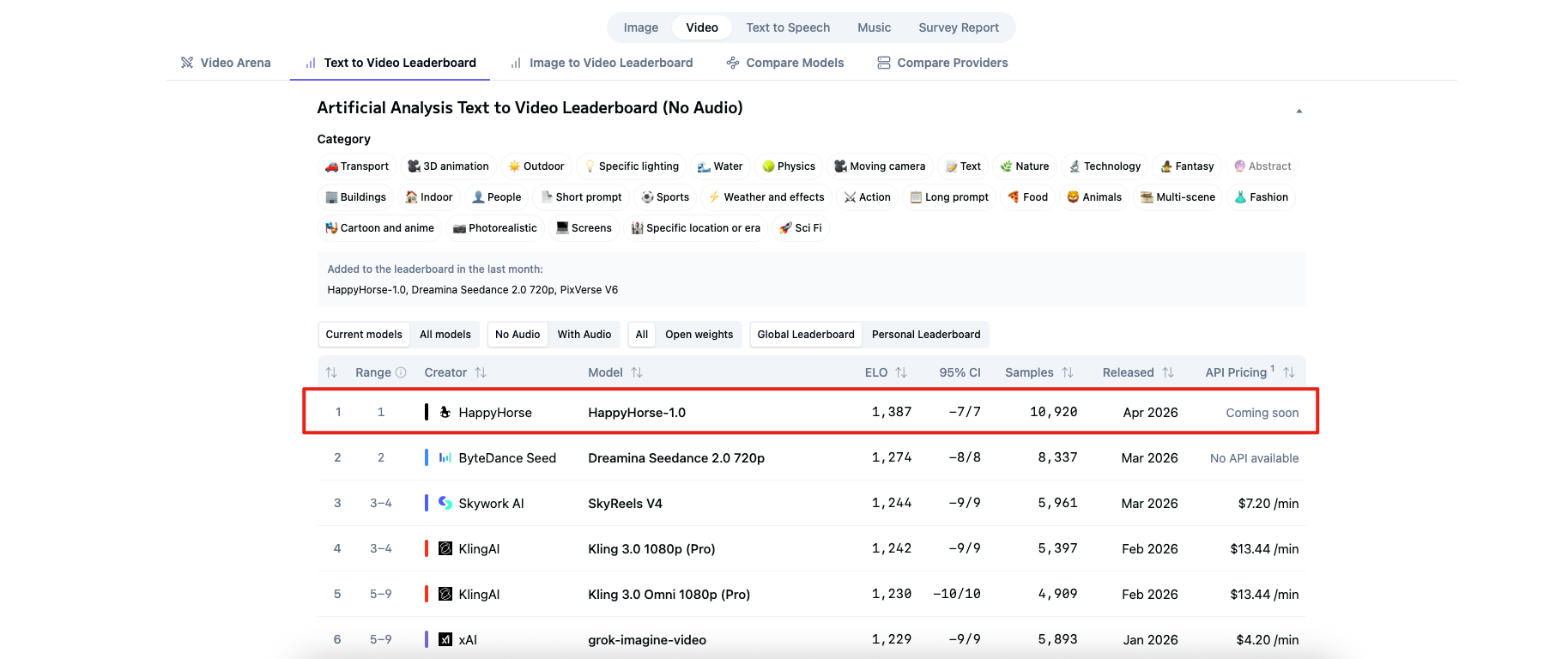
Based on the public record available on April 9, 2026, I would not describe HappyHorse-1.0 as fully open source in the same way as a model with clearly accessible weights, an auditable model card, and an obvious release trail. What is easy to verify today is that HappyHorse-1.0 leads Artificial Analysis’s text-to-video leaderboard without audio at Elo 1386, and Artificial Analysis says it was added to the leaderboard in the last month.
The harder part is the rollout story. Public pages make strong claims about open-source availability, commercial rights, and GitHub release status, but other public pages still describe the codebase and weights as being in final staging, while the visible Hugging Face profiles most plausibly associated with the project show zero public models.
Here is the cleanest way to frame it.
Verified: HappyHorse-1.0 is currently the top-ranked no-audio text-to-video model on Artificial Analysis, with API pricing still marked “Coming soon.”
Claimed: Several public pages describe the model as fully open source and commercially usable.
Still missing: A release trail that is as easy to audit as the claim itself. The same public record also includes “weights go live” language, “Preparing Release Package” language, and Hugging Face profiles with no public models.
What is verified right now
HappyHorse-1.0 clearly exists as a real entry on Artificial Analysis’s leaderboard. Artificial Analysis lists it as the no-audio text-to-video leader at Elo 1386, with 10,804 samples, a release month of April 2026, and API pricing marked “Coming soon.” The same page says HappyHorse-1.0 was added to the leaderboard in the last month.
That matters because it separates the strongest public fact from the noisiest one. The strongest fact is not “it is open source.” The strongest fact is “it is performing at the top of a live public leaderboard.” Artificial Analysis’s model-family page for HappyHorse is still sparse and says “More details coming soon,” which is a meaningful gap if you are trying to audit provenance, release scope, or deployment readiness.
An even more revealing detail appears on the same leaderboard page. In Artificial Analysis’s FAQ, the current leader among open weights text-to-video models without audio is listed as LTX-2 Pro, not HappyHorse-1.0. That does not prove HappyHorse-1.0 is closed. It does suggest that the public record is not yet clean enough to treat HappyHorse-1.0 as the obvious open-weights leader in the same way you would treat a model with plainly visible downloadable weights.
Why the open-source story is still incomplete
The public claims are strong, but they do not line up neatly. The site happyhorse-model.com says “Complete release” and “commercial use included,” yet the same page also asks readers to “Get notified when HappyHorse weights go live,” and the footer identifies the site as “An independent community resource” that is “Not affiliated with any official HappyHorse team.” That combination makes the page useful as a signal, but weak as proof.
A different public page, happyhorsegen.com, is even clearer about the release still being in progress. It says the “codebases and model weights are currently undergoing final staging,” labels the rollout as “Preparing Release Package,” and says public release documentation is still being finalized. If you are evaluating whether the model is already released in a normal open-source sense, that wording points in the opposite direction.
The press-release narrative is stronger still. It says HappyHorse-1.0 is “completely open-source with full commercial licensing,” that the “complete model is now publicly available,” and that full weights and inference code were released on GitHub. But a press release is only as strong as the release trail it points to, and the public record I reviewed does not yet provide an equally clean, easy-to-audit chain from claim to weights to license to documentation.
The visible Hugging Face profiles most plausibly tied to the naming pattern do not close that gap. Both happyhorse and happy-horse currently show zero public models, and the happy-horse datasets page also shows none public yet. That does not prove there is no release elsewhere. It does mean that the public release is not yet obvious in the places many readers would expect to verify it.
One more wrinkle comes from happyhorses.io. Despite some search-result snippets framing it like an official model page, the page itself says HappyHorse is a capability inside the HappyHorses platform, “not offered as a standalone model,” and that the platform does not claim ownership of the underlying model technologies. That is a very different story from “official standalone open-source model release.”
What a real open-source release would normally include
For a claim like “fully open source” to feel settled, readers should be able to follow a short, auditable path: a public repository, public weights, a license that can be read directly, a model card or technical note, and enough documentation to reproduce inference without guesswork.
That is the standard HappyHorse-1.0 has not yet met in the public record I reviewed. Artificial Analysis confirms the model’s leaderboard presence, but its HappyHorse family page is still mostly blank. Public claim pages disagree on whether release is complete, in progress, or not even a standalone model offering. The visible Hugging Face pages do not present public model artifacts that make the claim easy to check.
That distinction matters because “open source” is not only a branding word. For teams, it has operational meaning. It affects whether you can self-host, audit commercial rights, review known limitations, and decide whether the model belongs in a production workflow rather than a watchlist.
What this means for creators, teams, and developers
If you are a researcher, model watcher, or frontier-video evaluator, HappyHorse-1.0 is absolutely worth paying attention to. A model can be real, important, and leaderboard-leading before its release story is fully legible, and that appears to be the best current interpretation here.
If you are a team that needs self-hosting now, clean commercial rights now, or enterprise-grade provenance now, the more practical stance is to wait. Based on the available evidence, HappyHorse-1.0 looks leaderboard-verified but not yet fully open-source-verifiable. That is a meaningful difference if procurement, compliance, or internal deployment is part of the decision.
If you are a creator deciding whether to track the model, the answer is yes. If you are deciding whether to treat it like a mature open-weights release on the same footing as a plainly downloadable model, the answer is not yet.
The most practical conclusion
The public record supports a narrower, more accurate sentence than the marketing pages do: HappyHorse-1.0 is a leaderboard-leading video model whose open-source release is still only partially verifiable from public evidence.
That wording is not anti-HappyHorse. It is just stricter about what has actually been demonstrated in public. Right now, the ranking is easy to verify. The release trail is not. Until the repo, weights, license, and documentation are all plainly visible and mutually consistent, “fully open source” is still stronger than the public evidence comfortably supports.
FAQ
Is HappyHorse-1.0 open source?
Not in a fully settled, easy-to-audit sense yet. Public pages make that claim, but the same public record also includes “weights go live” language, “final staging” language, and no obvious public model artifacts on the visible Hugging Face profiles.
What is definitely verified about HappyHorse-1.0?
Its leaderboard presence is definitely verified. Artificial Analysis currently lists HappyHorse-1.0 as the no-audio text-to-video leader at Elo 1386 and says it was added in the last month.
Does Artificial Analysis treat HappyHorse-1.0 as the leading open-weights model?
Not on the text visible in the current public FAQ. On the same leaderboard page, Artificial Analysis says LTX-2 Pro currently leads among open-weights text-to-video models without audio.
Can I verify public weights or a public model card today?
I could not verify a clean public release path from the sources reviewed here. The visible Hugging Face profiles tied to the most likely project names show zero public models, and Artificial Analysis’s HappyHorse family page still says “More details coming soon.”
Why do public pages disagree so much?
Because they appear to be serving different roles. Some pages look like community explainers, some like generator landing pages, some like release-prep pages, and some like press amplification. Those are useful for signals, but they do not add up to the same thing as a single authoritative, auditable release page.


Why HappyHorse-1.0 Is #1 on AI Video Leaderboards
HappyHorse-1.0 now leads key AI video rankings, but the real story is what the leaderboard measures, what remains unclear, and what creators should do next.
By Mwang 一 Apr 08, 2026- AI Video
- AI Video Generator
- HappyHorse
HappyHorse-1.0 vs Seedance 2.0: Quality or Access?
Compare HappyHorse-1.0 and Seedance 2.0 on quality, access, workflow fit, and risk to see which AI video model makes more sense for creators.
By Mwang 一 Apr 08, 2026- AI Video
- AI Video Generator
- HappyHorse

What Is HappyHorse-1.0? The Mystery AI Video Model Overtaking Seedance 2.0
Right now, HappyHorse-1.0 is best understood as a mystery AI video model that has rapidly gained attention for its strong text-to-video performance. It is anonymous, it does not yet have the kind of mainstream product presence that other major models have, and it is still surrounded by speculation.
By Mwang 一 Apr 08, 2026- AI Video Generator
- HappyHorse
- AI Video
- X
- Youtube
- Discord