
'%3e%3cg%3e%3cpath%20d='M12.04834,6.05824C12.09325,4.8457799999999995,12.43703,3.78081,13.0715,2.89055C13.7092,1.995784,14.7633,1.3601670000000001,16.2063,1C16.215899999999998,1.0440338,16.2259,1.088092,16.2363,1.131979L16.2363,1.3623509999999999C16.2363,1.884725,16.1084,2.48372,15.856,3.14258C15.5915,3.78052,15.1781,4.38093,14.6291,4.92281C14.1157,5.40028,13.6406,5.71638,13.2207,5.85928C13.0822,5.9003,12.89209,5.94066,12.66255,5.97701C12.45842,6.00853,12.25362,6.03563,12.04834,6.05824ZM12.28933,7.85741C10.6594,7.85741,9.52778,6.42896,7.91997,6.42896C6.31224,6.42896,3,7.89332,3,12.9488C3,18.0043,5.94131,21.2617,6.27029,21.642C6.599209999999999,22.0224,7.36005,23,8.5387,23C9.71744,23,11.00787,22.0715,12.28933,22.0715C13.5707,22.0715,15.1836,23,16.2365,23C17.2895,23,17.7226,22.5747,18.4392,21.8411C19.1558,21.1074,20.5227,18.8686,21,17.5248C20.2137,17.061,18.1298,15.8019,18.1298,12.9488C18.1298,11.0468,18.831200000000003,9.4667,20.2341,8.20853C19.3138,7.02216,18.2464,6.42896,17.0318,6.42896C15.2099,6.42896,13.9193,7.85741,12.28933,7.85741Z'%20fill='%23000000'%20fill-opacity='1'/%3e%3c/g%3e%3c/g%3e%3c/svg%3e)
'%3e%3cg%3e%3cpath%20d='M6.2985500000000005,2L14.60082,10.81153L16.7432,8.537289999999999C13.81573,6.65184,9.89484,4.122529999999999,8.13152,2.985321L6.95017,2.225593C6.74135,2.090554,6.5177700000000005,2.0178354,6.2985500000000005,2ZM5.0312551,3.05499C5.0144537,3.1518100000000002,5,3.24911,5,3.35357L5,20.7675C5,20.8406,5.0138389,20.9085,5.0234395,20.9782L13.4695,12.0125L5.0312551,3.05499ZM18.1511,9.444659999999999L15.7321,12.0125L18.1089,14.5354C19.3682,13.7252,20.2405,13.1626,20.3372,13.1007C20.7653,12.8229,21.007,12.4039,20.9998,11.94614C20.9934,11.49683,20.7516,11.09514,20.340400000000002,10.84799C20.2484,10.79194,19.387999999999998,10.24048,18.1511,9.444659999999999ZM14.60082,13.2134L6.3235600000000005,22C6.48437,21.9703,6.64498,21.9194,6.79859,21.8209C7.01141,21.6833,12.76069,17.9805,16.701,15.4428L14.60082,13.2134Z'%20fill='%23000000'%20fill-opacity='1'/%3e%3c/g%3e%3c/g%3e%3c/svg%3e)

Dreamface vs HeyGen for Video Translation
Compare Dreamface and HeyGen on lip-sync, voice preservation, workflow, language coverage, and team control to choose the right video translator.
- AI Translator
- AI Video Translator
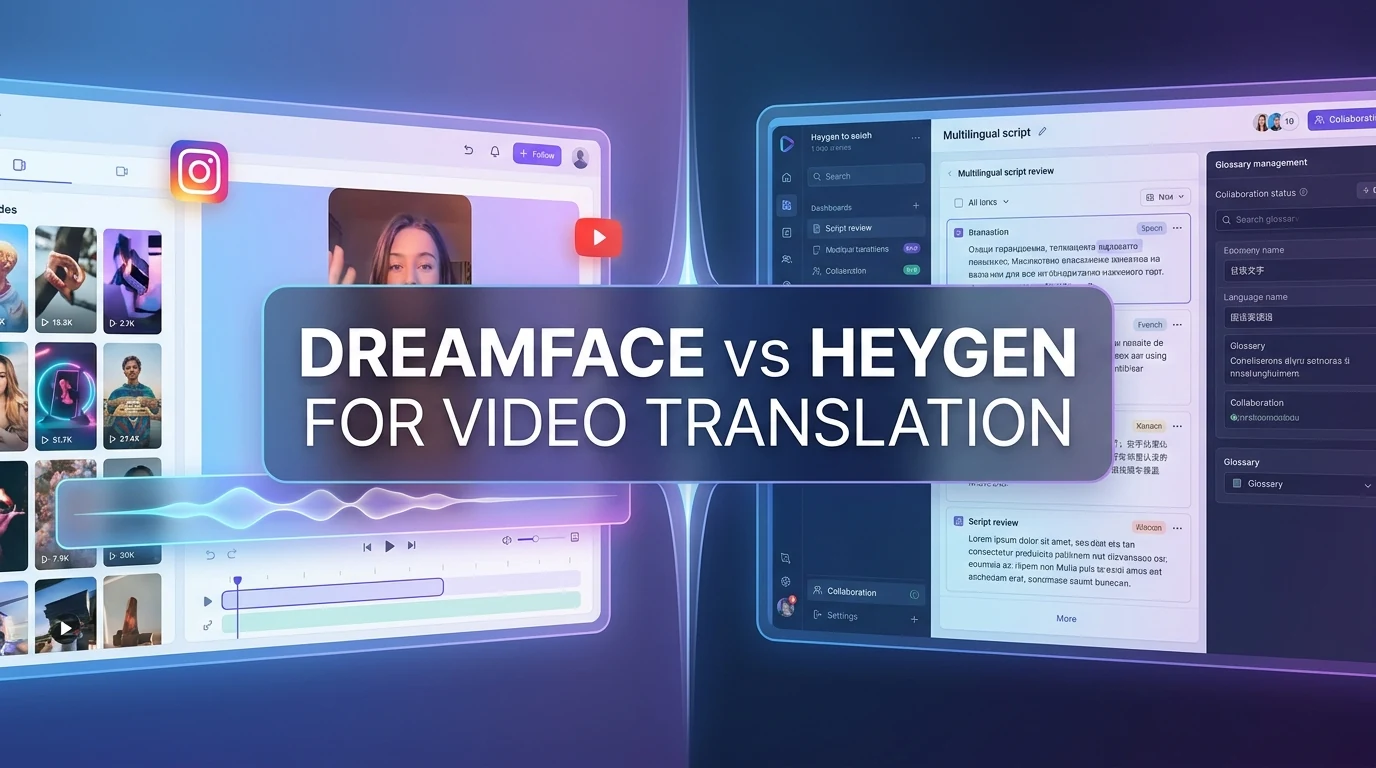
If you are choosing between Dreamface and HeyGen for video translation, the real difference is not whether both tools can translate video. They can. The more useful question is what kind of workflow each one is built for. Based on the public product pages available today, Dreamface is positioned more like a fast, creator-friendly localization workflow, while HeyGen is positioned more like a translation system with stronger review, terminology, and team controls.
That leads to a simple verdict. Dreamface makes more sense if you want to localize short-form content quickly and keep the process simple. HeyGen makes more sense if you need broader language coverage, more control over the translated script, and a clearer path for teams that need approval and review steps.
Quick verdict
- Choose Dreamface if your priority is fast content localization for social videos, short-form marketing, or creator workflows.
- Choose HeyGen if your priority is translation control, proofreading, brand terminology, and team collaboration.
- Wait before choosing either one if your videos are highly sensitive, terminology-heavy, or require near-human review quality in every language.
The summary below is based on Dreamface’s public translator page and HeyGen’s public translate, pricing, and proofread pages.
| Category | Dreamface | HeyGen |
|---|---|---|
| Best for | Fast creator localization | Team-grade localization control |
| Public translation positioning | Simple upload-to-export workflow | More configurable translation workflow |
| Public language claim | Multiple major languages named publicly | 175+ languages and dialects |
| Review controls | Simpler public flow | Edit, review, and proofread flow |
| Team workflow | Content-team friendly positioning | Clearer business and enterprise collaboration story |
| Public strength | Batch localization, lip-sync, ready-to-publish output | Language breadth, glossary, proofreading, collaboration |
| Public drawback | Fewer translation governance details on the reviewed page | More process can mean more workflow weight |
What this comparison actually comes down to
A lot of comparison articles stop at feature lists. That is not enough here. Both products promise AI dubbing, lip-sync, and multilingual output. The practical difference is where each company puts its public emphasis. Dreamface highlights natural pacing, batch translation, lip-sync timing, and an all-in-one path from upload to final export. HeyGen highlights 175+ languages, YouTube link input, up to 10 simultaneous target languages, brand glossary support, and an edit-and-proofread layer before final generation.
That matters because most buyers are not comparing two abstract AI products. They are comparing two ways to get multilingual video out the door. One path is optimized for speed and simplicity. The other is optimized for control and review.
Which one feels easier for fast video localization?
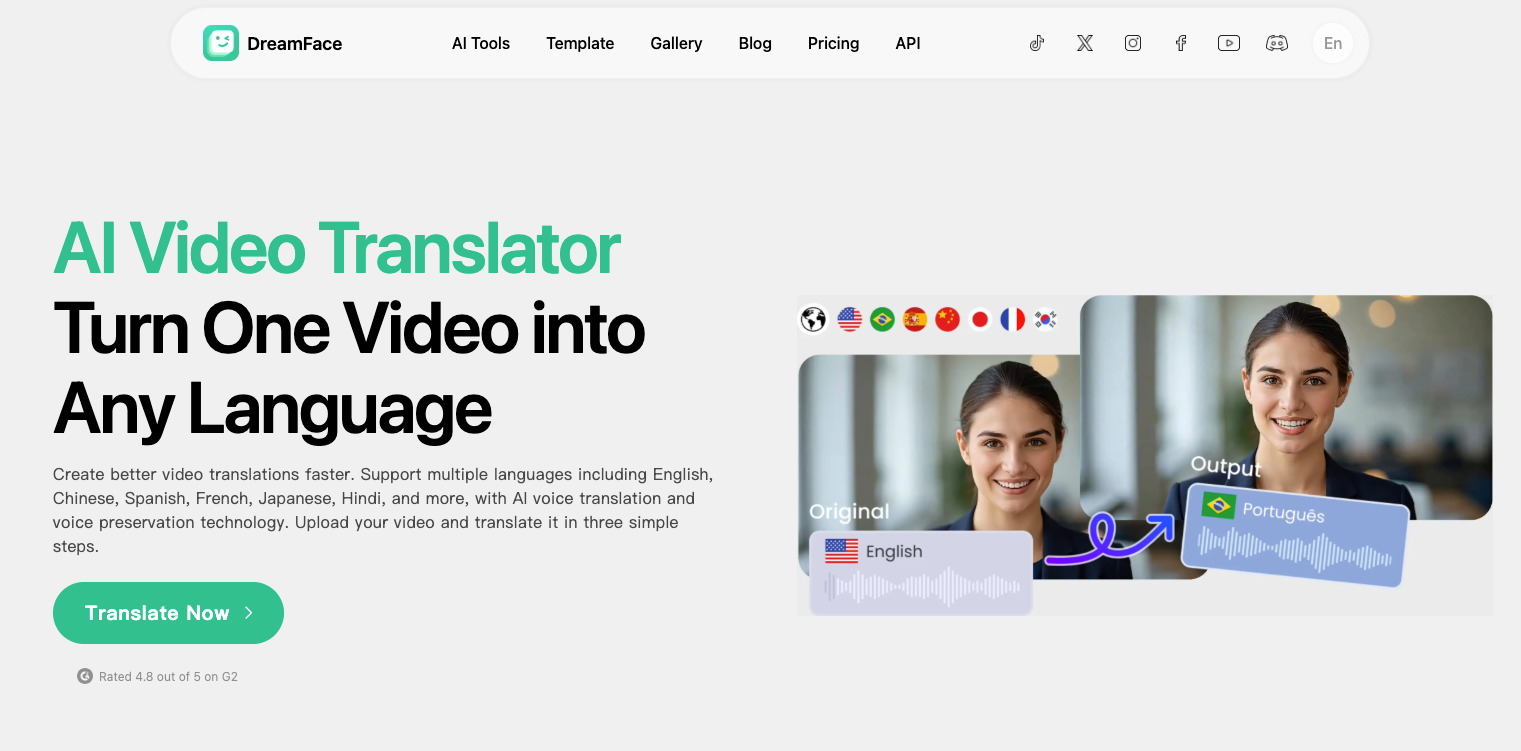
Based on the available evidence, Dreamface looks easier to justify for creators who care most about speed and simplicity. Its public page is very direct: upload a video, choose a language, translate, download. It also explicitly highlights batch translation, advanced lip-sync and timing optimization, and a ready-to-publish workflow designed for creators, marketers, and global content teams.
That is a strong fit for short-form content. If you are localizing TikTok clips, short ads, creator videos, or story-driven social content, the Dreamface message is easy to understand: fewer moving parts, fewer handoffs, faster output. The public copy keeps returning to the same promise of smoother pacing, simpler localization, and less post-production overhead.
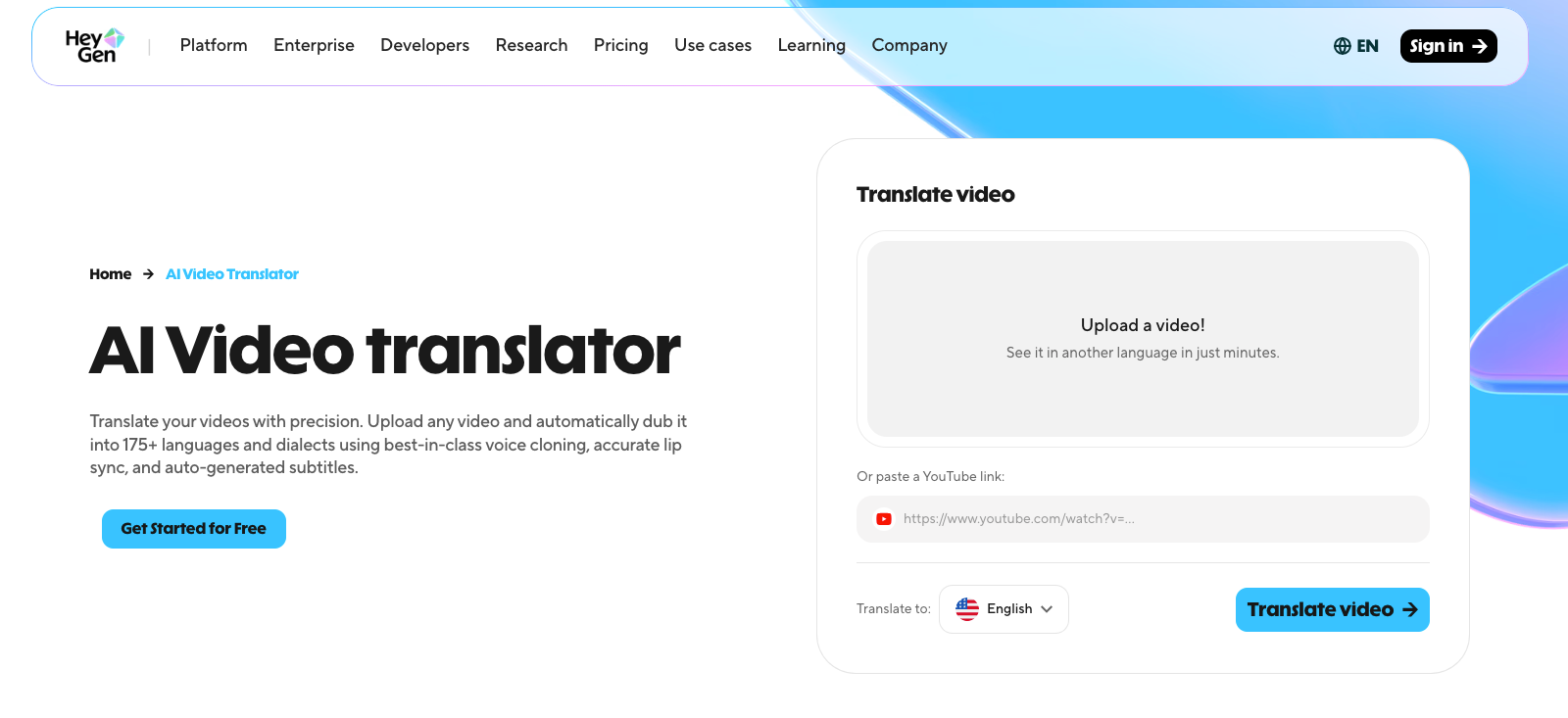
HeyGen is not hard to understand, but its public flow suggests a heavier system. The translate page starts simply enough, yet it quickly moves into options like translation engine choice, up to 10 simultaneous languages, Edit & Review, brand glossary support, and proofread steps. That is excellent if you want more control. It is less ideal if you just want to upload a clip and get a multilingual version out quickly.
So if your main question is, “Which one helps me move faster with fewer decisions,” Dreamface has the cleaner public story. If your question is, “Which one gives me more places to review and refine the translation before it goes live,” HeyGen has the clearer answer.
Which one gives you more control over the translated script?
This is where HeyGen has the clearest public edge. Its translate page explicitly says users can choose up to 10 languages at once and then use Edit & Review to proofread the translated script before finalizing. Its Academy proofread guide goes further, showing brand glossary settings, subtitle upload support, editable translated scripts, offline script export and re-upload, optional audio-only translation, and even the option to invite a proofreader.
That is a meaningful difference. For a creator making social clips, script proofreading may be optional. For a brand team localizing product videos, training materials, or campaign assets, it can be the difference between a usable workflow and a risky one. The more practical conclusion is that HeyGen is not just promising translation quality. It is also promising a stronger review layer before the final file is generated.
Dreamface’s public translator page is more streamlined. It talks about translation, dubbing, timing alignment, lip-sync, and final export in one workflow, but it does not present the same translation-specific review stack on the page that HeyGen does in its product, pricing, and proofread materials. That does not mean Dreamface cannot be effective. It means the reviewed public materials make Dreamface look simpler and HeyGen look more controllable.
Which one is more likely to look and sound natural?
Both companies make strong public claims around natural output. Dreamface emphasizes natural speech rhythm, realistic voice pacing, and advanced lip-sync with timing optimization. HeyGen emphasizes voice preservation, accurate lip-sync, preserved tone and delivery, and brand-aware localization controls.
Because this article is not based on hands-on testing, the honest answer is that I would not treat either company’s marketing language as proof that one is categorically better in every case. The safer reading is that Dreamface publicly leans into “smooth viewer experience” and “ready-to-publish social content,” while HeyGen publicly leans into “authentic voice preservation” and “controlled localization.” Those are related promises, but they are not the same promise.
That distinction matters in real use. If your content is dialogue-heavy, emotional, and made for short-form engagement, Dreamface’s focus on pacing and timing is easy to see as a creator advantage. If your content needs wording precision, brand consistency, or stakeholder review before publishing, HeyGen’s proofread and glossary features are easier to trust on paper.
Which one is better for creators, and which one is better for teams?
Dreamface looks better aligned with creators and lightweight content teams. Its public translation page repeatedly points to creators, marketers, and global content teams, and it frames the product around simple steps, batch translation, timing alignment, and polished export without extra editing. Its public explainer post also frames AI video translation as a way to avoid re-recording, reduce production time, and scale content across languages more efficiently.
That makes Dreamface especially easy to recommend for short video localization, creator-led publishing, repeatable social content, and teams that want fewer tool switches. It feels like a good match for people who care about output speed and content cadence more than enterprise review logic.
HeyGen looks better aligned with teams that need a stronger operating system around translation. Its public materials show a much more explicit structure for pricing tiers, language limits, proofread features, business seats, workspace collaboration, video comments, role controls, and proofreader access. That is a much clearer public story for teams handling campaigns, training libraries, regional rollouts, or multilingual brand governance.
The practical takeaway is simple. Dreamface is easier to picture inside a creator pipeline. HeyGen is easier to picture inside a managed team pipeline.
Does pricing change the decision?
HeyGen makes pricing easier to compare because its public pricing page clearly maps translation features to plan levels. The Free plan includes trial access to video translation with lip sync and 30+ languages. The Creator plan lists 175+ languages and dialects. Pro adds edit and proofread translation script. Business adds workspace collaboration, team members, and draft commenting, while Enterprise adds proofreader seats and more centralized controls.
That transparency is useful because it tells you what kind of user HeyGen thinks each plan is for. It also reinforces the product story from the translate and proofread pages: HeyGen is not only selling translation output, but translation operations.
Dreamface’s public translator page is less pricing-led and more workflow-led. For this comparison, that means I would not force a neat price-to-price battle unless both sides publish directly comparable translation tiers in the same level of detail. The stronger interpretation is that Dreamface wins more on simplicity and content workflow, while HeyGen wins more on published operational depth.
What each one still gets wrong
Dreamface’s public materials make the product sound easy to adopt, but they leave more unanswered questions for buyers who care about review layers, terminology governance, and team permissions. If you are evaluating translation as a managed business workflow, the public page is simply less detailed than HeyGen’s set of product, pricing, and proofread materials.
HeyGen’s public materials are strong on control, but that strength comes with more visible process. For many teams, that is a good thing. For solo creators or fast-moving social teams, it can also look heavier than necessary. More options are helpful only when you actually need them.
There is also a broader caution for both products. Dreamface tells users to upload videos with clear speech and no singing for accurate translation, which is a useful reminder that AI video translation still works best when the source audio is clean. The same common-sense warning applies more broadly across the category: if the source is noisy, jargon-heavy, or performance-sensitive, human review still matters.
Final recommendation
Choose Dreamface if your main job is to turn one video into multiple localized versions quickly, especially for creator content, short-form marketing, and social storytelling. Its public translation story is built around speed, natural pacing, batch localization, and polished output with less friction.
Choose HeyGen if your main job is to control the translation process, not just generate the result. Its public materials make a much stronger case for script review, glossary control, team collaboration, and tiered translation operations.
If you want the shortest possible answer, it is this: Dreamface is the better fit for fast creator localization, and HeyGen is the better fit for controlled team localization.
FAQ
Is Dreamface better than HeyGen for short-form video translation?
Dreamface looks better suited to short-form localization if speed and simplicity are your top priorities. Its public page emphasizes batch translation, lip-sync timing, and ready-to-publish output for creators, marketers, and content teams.
Is HeyGen better for business and team use?
HeyGen has the stronger public case for business and team use. Its pricing and proofread materials explicitly list script review, brand glossary support, collaboration features, proofreader access, and role-based workflow features that Dreamface’s reviewed translation page does not detail to the same extent.
Which one is better for keeping the speaker’s original voice?
Both products publicly emphasize natural output, but HeyGen makes voice preservation a more explicit part of its translation story. Dreamface focuses more on natural pacing, realistic voice flow, and lip-sync timing.
Which one is better for translating into many languages at once?
HeyGen has the clearer public claim here. Its translate page says users can choose up to 10 languages simultaneously, and its pricing page lists 175+ languages and dialects on paid plans.
Which one is better if I just want to upload and go?
Dreamface is the simpler fit if your ideal workflow is upload, choose a language, translate, and download. That is exactly how its public page frames the product.
How to Keep Your Original Voice in AI Video Translation
Learn how to preserve your voice, tone, and speaking style when translating videos with AI, and when subtitles or re-recording are the better choice.
By Kitty一Apr 17, 2026- AI Translator
- AI Video Translator
How to Create a Multilingual Talking Avatar or Photo
Learn how to make a talking avatar or talking photo in multiple languages, choose the right workflow, and avoid lip-sync, voice, and subtitle mistakes.
By Jonathan一Apr 17, 2026- AI Video
- AI Translator
- AI Video Translator
AI Video Translation QA Checklist: What to Catch
Catch lip-sync, timing, voice, and subtitle mistakes before you publish. A simple QA checklist for creators, marketers, and localization teams.
By Luna一Apr 17, 2026- AI Video
- AI Translator
- AI Video Translator